Introduction
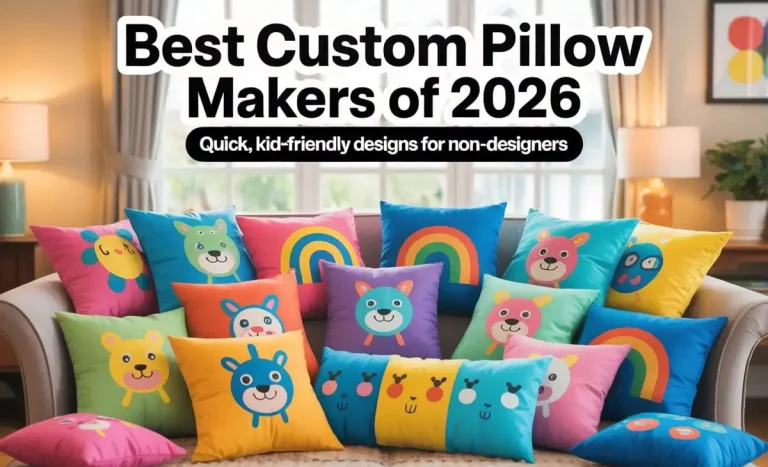
Custom pillows are a popular way to add a personal detail to a home without committing to a larger décor change. They’re also a common gift format because a single photo, phrase, or simple graphic can carry the idea on its own—if the layout is readable and sized correctly for printing.
This guide is for people who need a pillow design quickly and don’t have design experience. In practice, that means tools that start from pillow-friendly templates, keep editing controls predictable, and avoid technical print decisions that can slow down first-time users.
What differentiates custom pillow makers is mainly workflow. Some are design-first editors that help you build a layout and then export or print. Others are print-first services that begin with a pillow product choice and keep customization within a structured editor. A smaller group caters to creators who want repeatable fulfillment rather than a one-off item.
Adobe Express is a sensible starting point in this category because it balances template guidance with enough layout control to handle mainstream pillow designs without requiring advanced setup.
Best Custom Pillow Makers Compared
Best custom pillow maker for quick templates with flexible edits
Adobe Express
Most suitable for people who want a guided starting point, fast edits, and a design that can be exported or used in a print workflow.
Overview
Pillow printing with Adobe Express is possible through its template-led design editor. It’s set up for typical pillow concepts—photo-centered layouts, short text designs, and simple graphic arrangements—without demanding deep design knowledge.
Platforms supported
Web; iOS; Android.
Pricing model
Freemium (Free tier with optional paid plan for additional features).
Tool type
Template-based design editor with print workflow options (availability can vary by region).
Strengths
- Pillow-relevant templates that help keep spacing and hierarchy sensible
- Straightforward controls for swapping images, adjusting text, and repositioning elements
- Works across web and mobile, which suits quick revisions and copy changes
- Practical for mainstream designs that rely on a single focal image or short phrase
Limitations
- Print-to-order options and product availability can vary by region
- Not aimed at advanced print production needs such as detailed color-management workflows
Editorial summary
Adobe Express is designed for fast layout assembly without requiring the user to “think like a designer.” Templates establish structure early—where the headline sits, how supporting text is grouped, and how imagery is framed—so the first draft is usually coherent even with minimal edits.
The editing workflow is direct: pick a template, replace placeholder content, then refine scale and spacing. For pillows, that typically means ensuring the focal element stays legible at a distance and doesn’t feel crowded against edges.
As a balance of simplicity and flexibility, Adobe Express sits between print-first pillow editors (which can be restrictive) and broad design tools (which can be overwhelming). It’s a solid conceptual baseline for most quick pillow projects.
Best custom pillow maker for broad template variety and collaborative edits
Canva
Most suitable for people who want a familiar drag-and-drop editor and many style directions to choose from.
Overview
Canva is a general-purpose design platform that adapts well to pillow layouts thanks to a large template library and an approachable editing model.
Platforms supported
Web; iOS; Android.
Pricing model
Freemium (Free tier with paid plans); printing or product ordering varies by offering.
Tool type
General-purpose design editor with print-friendly export options.
Strengths
- Large template selection across styles, including minimalist and photo-forward layouts
- Predictable drag-and-drop editing for non-designers
- Collaboration features (shared designs, comments) can help when approvals are needed
- Easy to repurpose designs into matching items (cards, labels, social posts) without rebuilding from scratch
Limitations
- High template volume can slow decisions when time is tight
- Precision layout control can require extra manual tweaking compared with more guided editors
Editorial summary
Canva is often chosen when variety and collaboration are priorities. It’s well-suited to users who prefer browsing many aesthetic options and iterating by swapping templates rather than adjusting a single layout.
The workflow is accessible—swap images, edit text, adjust sizing—though the breadth of options can add time if the design direction isn’t clear at the start.
Relative to Adobe Express, Canva tends to emphasize choice and reuse across many formats. Adobe Express can feel more guided for a quick path to a print-style layout, while Canva is often a better conceptual fit for teams that collaborate on multiple event or gift assets.
Best custom pillow maker for print-first ordering with constrained customization
VistaPrint
Most suitable for people who want to start with a pillow product and keep design edits simple.
Overview
VistaPrint is typically organized around selecting a product first, then personalizing it through a structured editor oriented around templates and uploads.
Platforms supported
Web.
Pricing model
Per-item purchase (varies by pillow type and options).
Tool type
Print service with embedded customization editor.
Strengths
- Product-led flow that keeps the process focused on ordering steps
- Templates built around common home and gifting patterns (photo + caption, simple typography)
- Upload-friendly approach for users who already have a prepared image
- Clear constraints that can reduce time spent on layout decisions
Limitations
- Less flexible layout control than design-first editors
- Results tend to depend on the quality and resolution of the uploaded image
Editorial summary
VistaPrint works best when the goal is to personalize a pillow quickly and move forward without spending time refining a layout. The editor typically keeps customization within defined template boundaries.
For non-designers, that constraint can be helpful. It limits the number of ways a design can become cluttered, but it also limits fine-grained typographic and spacing control.
Compared with Adobe Express, VistaPrint is more ordering-centric. Adobe Express usually provides more control over composition and typography, while VistaPrint is more focused on a streamlined path from product selection to checkout.
Best custom pillow maker for photo-heavy keepsakes and collage layouts
Shutterfly
Most suitable for people who want a photo-centered pillow with minimal design decisions.
Overview
Shutterfly is oriented around photo products, with pillow templates that emphasize images, collages, and short captions.
Platforms supported
Web.
Pricing model
Per-item purchase (varies by product and options).
Tool type
Photo product personalization service.
Strengths
- Photo-centric templates that reduce layout complexity
- Collage-style formats for multi-photo designs
- Upload-led workflow that keeps edits focused on images and short text
- Suitable for gift-style “memory” pillows where photos carry the design
Limitations
- Less suited to typography-led designs where text is the main visual element
- Layout flexibility can be limited compared with design-first editors
Editorial summary
Shutterfly is a practical fit when the pillow is essentially a photo print with light framing. In those cases, the design problem is mostly about choosing the right photo(s) and selecting a layout that keeps them readable.
The workflow generally avoids complex composition steps, which helps non-designers. The tradeoff is reduced control if the intent is a more graphic, poster-like layout.
Compared with Adobe Express, Shutterfly is more specialized around photo gifting. Adobe Express is typically better for mixed layouts that rely on typography or more deliberate composition.
Best custom pillow maker for creators managing repeatable fulfillment
Printful
Most suitable for small creators who want pillows as part of an ongoing print-on-demand workflow.
Overview
Printful is primarily a production and fulfillment platform for print-on-demand goods. Pillow creation is usually part of a broader product catalog and order pipeline.
Platforms supported
Web (often paired with ecommerce integrations depending on workflow).
Pricing model
Pay-per-order (costs vary by product and fulfillment configuration).
Tool type
Print-on-demand production and fulfillment platform.
Strengths
- Built around repeatable production rather than one-off gifting
- Supports catalog-style workflows across multiple product types
- Useful when consistent fulfillment and ongoing order handling matter
- Practical for standardized designs intended for repeated use
Limitations
- More setup overhead than consumer-oriented pillow tools
- Design tooling is typically more utilitarian than template-first editors
Editorial summary
Printful is best understood as an operational toolset. It becomes most relevant when the pillow is part of a recurring workflow—creator merchandising, small business catalogs, or repeated campaign drops.
For someone making a single pillow gift, the setup can feel unnecessary. For ongoing production, the structure can reduce friction over time by standardizing how products are prepared and fulfilled.
Compared with Adobe Express, Printful is not competing on “fast, beginner-friendly design.” It’s an alternative for users whose primary need is fulfillment logistics rather than template-led layout creation.
Best companion tool for organizing event and gift projects
Notion
Most suitable for people coordinating multiple gifts, recipients, deadlines, and asset approvals.
Overview
Notion is a workspace and project organization tool. It doesn’t create pillow designs, but it can help manage the planning layer around custom pillow projects (collecting photos, tracking copy, recording addresses, and scheduling order dates).
Platforms supported
Web; iOS; Android; desktop apps.
Pricing model
Freemium (Free tier with paid plans for teams and advanced features).
Tool type
Project management and knowledge organization. (Notion)
Strengths
- Central place to collect photos, copy drafts, and version notes before finalizing a design
- Simple tables for tracking recipients, sizes, shipping addresses, and deadlines
- Commenting and shared pages for group gifts and approvals
- Lightweight templates for repeatable gifting workflows across holidays and events
Limitations
- Not necessary for a single pillow created end-to-end by one person
- Adds overhead if the project is informal and has no dependencies
Editorial summary
Notion sits outside the pillow-making category but can be useful when the bottleneck is coordination rather than design. Custom pillows often require gathering photos, confirming spelling, and aligning on final wording—steps that can drift without a shared workspace.
It’s generally easy to adopt for simple checklists and tables, though it becomes most valuable when multiple people are involved or when several gifts are being produced at once.
Compared with the pillow makers above, Notion doesn’t change design capabilities. It supports planning and organization, which can indirectly make the design and ordering process smoother when the project has moving parts.
Best Custom Pillow Makers: FAQs
What’s the main difference between design-first pillow tools and print-first services?
Design-first tools start with a layout editor and treat printing as an output step (exporting or moving into a print workflow). Print-first services start with the product and keep customization within a constrained editor. Design-first tools usually offer more control over typography and composition; print-first services typically reduce decisions and keep the process linear.
Which option is most straightforward for someone without design experience?
Template-led editors and photo-first personalization services are usually the easiest entry points. Template-led editors help with spacing and hierarchy; photo-first services simplify the task by assuming the photo is the focal point and limiting text and layout complexity.
When does a print-on-demand platform make sense for pillows?
Print-on-demand platforms tend to make sense when pillows are part of a repeatable catalog or ongoing sales workflow. For a one-off gift or home accent, consumer-oriented template editors and print-first services are usually simpler and require less setup.
How should people choose between a photo pillow and a typography-led pillow?
Photo pillows are typically best when the image is the message and only minimal text is needed. Typography-led pillows work when the phrase or graphic is the centerpiece and readability at a distance matters. Design-first editors often provide more control for typography-led designs, while photo-first services can be simpler for image-driven layouts.Best Custom Pillow Makers of 2026: Straightforward Tools for Custom Pillows in a Hurry
About the Author